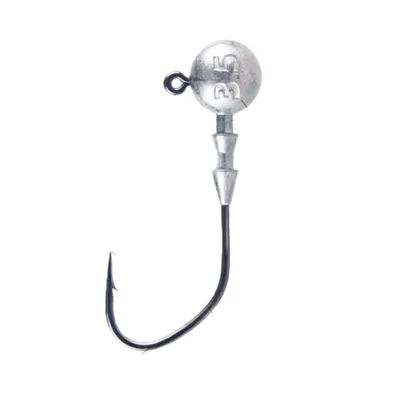
The production process of fishhook can be generally divided into: steel selection, wire cutting, sharpening, mid cutting, molding, heat treatment, electroplating, packaging and shipping. First of all, the choice of steel is a very important step in the process of making fishhooks. What kind of steel will directly lead to the toughness and strength of fishhooks. As we all know, pig iron is brittle and easy to break. The main reason is that there are too many elements such as carbon, phosphorus and sulfur in pig iron, which leads to the brittleness of pig iron. Similarly, if the content of carbon, phosphorus and sulfur in fishhook steel is too high, it will also cause the characteristics of fishhook brittleness and easy to break. Pure iron is relatively soft and easy to rust. Theoretically, completely pure iron does not exist, that is, if iron without impurities (carbon, phosphorus, sulfur) is not suitable for fishing hooks, even if it is really made, it is easy to be straightened by big fish. So when choosing fishhooks, don't believe the words of sellers such as high carbon fishhooks and pure carbon fishhooks. They look very professional and what they say is fallacies. Only when the carbon content is appropriate (0.8%-1.0%), can a good fish hook be made. More or less carbon content is not suitable for fishing hooks.
Wire cutting: that is to say, cut the long strip of steel into small strips suitable for making fishhooks. This step is usually done by machines, so the length is different, so there is the next step of mid cutting. The so-called mid cut is to make the fishhook the same size and length, that is, the same model. These two parts affect the size of the overall hook, and have little effect on a single hook. Sharpening: this step is very critical. The hook tip directly affects the fish feeding rate. The hook is sharp, and the fish bites the hook frequently, but the rod is often empty. Whether the hook tip is sharp or not, some people use the hook tip to scrape gently on their nails. If they can hook the nail, it means that the hook tip is sharp, and if they can't hook it, it means that the hook tip is not good. This also makes sense. For theoretical observation, it is necessary to use a high-power magnifying glass. The resolution of the naked eye cannot see whether the hook tip is stopped. In addition, the fishhook needs to be replaced after being used for a period of time. First, the water in nature is slightly acidic. The fishhook is slowly corroded in the water. No matter how good the steel is, it can't resist the corrosion of acid. Especially the friends of sea fishing, the salt content in the sea water is more and more corrosive, so it is more necessary to replace the fishhook frequently. Reason 2: when the rod is raised violently, the hook tip will collide with the upper jaw of the fish, and the hook tip will wear out after a long time. Molding: it's like making hook handles. Generally, the hook used is a flat hook handle, which requires that the hook handle should not be too flat, otherwise the hook is easy to hurt the sub line. If you encounter a big fish, the hook is OK, and the sub line is cut off by the hook handle, then wait for sadness. Therefore, the hook handle should not be too flat and sharp.
Heat treatment: this step is commonly known as quenching and tempering treatment by fishing friends. Quenching and tempering at different temperatures can make the fishhook have better strength, toughness and fatigue strength. The theoretical knowledge is to transform steel from austenite to martensite, and the steel with martensitic transformation is the hardest steel. I can't introduce martensite and austenite in detail here. If you have a concept, you won't be fooled by fishing gear merchants. Quenching may cause cold cracks in fishhooks, and tempering treatment can eliminate cold cracks, which requires mutual cooperation. Otherwise, the fishhook may also be brittle and easy to break. Unreasonable quenching and tempering will also affect the overall strength of the hook. Electroplating: the fishhook is black and needs to be plated with white nickel, which can resist corrosion and oxidation. Then the hook is made. There are many colors of hooks in the market, such as white, black, gold, red, blue and so on. The black hook is plated with black nickel on the hook, and the gold hook is plated with gold on the hook. Everyone feels that the gold hook is very expensive, but it is not. The thermos liner is plated with silver. Why doesn't anyone recycle the thermos liner? Because there is very little silver in such a large bottle, and there is also very little gold on the hook. After all, it's gold, so it's slightly more expensive than other hooks, but the cost will never exceed 1 cent. Real gold is not afraid of fire, so the corrosion resistance and oxidation resistance of gold hooks are super, which is why gold hooks are more durable. As for red, green and blue hooks, most of them are just painted with a layer of paint. (I can't say absolutely, because technology is being innovated) you will find that the paint is gone when you use it. Besides, the color is particularly conspicuous, which is not very beneficial for catching smooth mouth fish. It goes without saying that you can sell it by printing a box and loading it.
In this way, the process of making a fishhook is finished. The article does not say how to identify the strength of the hook bar of the fishhook, which is specially noted here. Use pliers to break the fishhook at a certain angle, and the fishhook will not stop. Break the fishhook back to its original shape continuously. Break it again, and the hook is broken. This kind of hook is perfect. When buying a hook in a fishing gear store, how to choose without pliers? Just press the hook handle to see if the hook has toughness. If it doesn't move, it means that the hook is brittle. If it's easy to press, it means that the hook is soft.